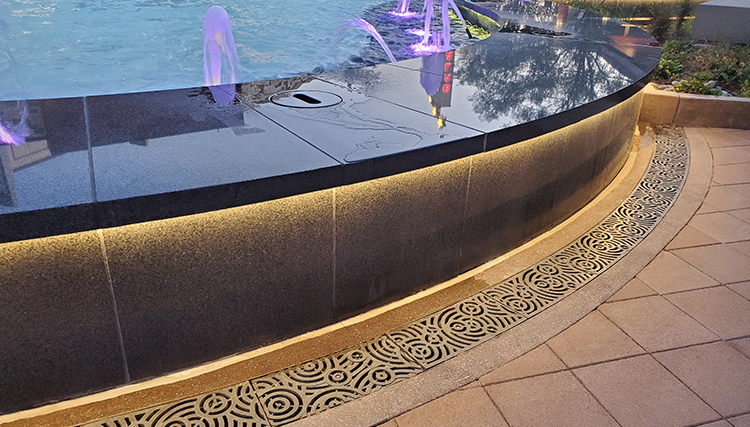
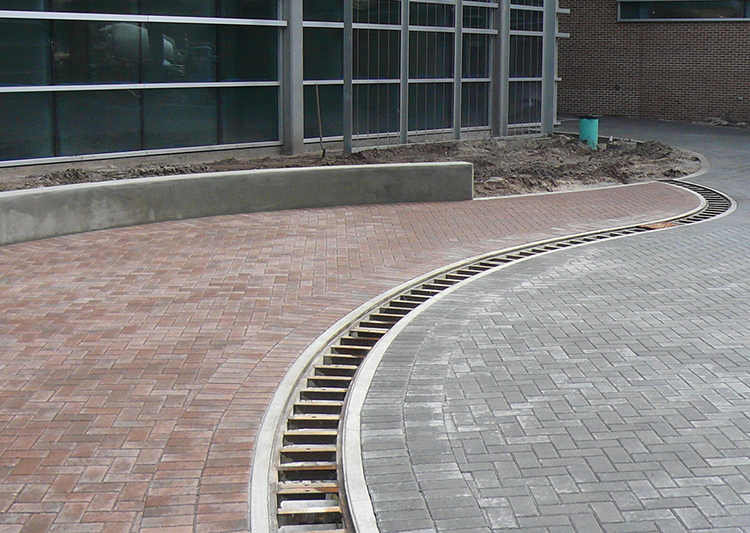
Iron Age can create cast metal trench grates on virtually any radius, in any of our standard designs, or in a fully custom pattern.
Because radius work typically requires a new casting pattern, custom radiused grates often involve pattern costs that can run several thousand dollars. To help avoid those charges, we maintain an inventory of existing radius patterns in a range of widths and radii.
Before requesting a custom radius, check the list below to see if an existing pattern will meet your needs and help avoid new pattern charges.
Iron Age Radius Trench Grates List — Click to Expand
Below you’ll find a table of Iron Age’s existing radius trench grates, organized by radius, design name, and width.
Curved trench installations require more coordination than straight runs. We’re happy to assist with layout, sizing, and frame selection, but first, the following details must be defined:
Regular Joe 12″ radiused trench in cast iron with baked-on-oil finish.
3. Radius & Layout Information
Radius trench projects are typically measured at the centerline (C.L.).
Please confirm:
What is the centerline radius?
How many runs are there?
What is the centerline arc length of each run?
If multiple runs exist, are all using the same width and radius?
Will partial castings be acceptable?
If partial castings are not acceptable, the overall run length must be adjusted to the nearest whole grate.
12″ radiused trench embedment frame with extra spreader bars to increase structural capacity.
4. Radius Frame Configuration
Nearly all radiused grates require custom frames fabricated by Iron Age.
Frames are formed from rolled angle bar and serve as the bearing surface for the grate. They are typically bolted in place or wet-set into the concrete edge. Because radius installations require frames rolled to match the specified radius, they are almost always made to order.
Before we can provide an accurate quote for radius frames, the following must be defined:
Frame Type: What installation condition are you working with?
Embedment (“E”) — For new concrete pours
Stand-Off Continuous (“SOC”) — For pavers on sand
Stand-Off Retro (“SOR”) — For pavers on mortar beds
For a detailed explanation of each frame type, please visit the Frames section in our FAQ.
Important Notes:
“R” & “IR” (Retrofit) frames are not recommended for radius installations.
To quote “SOC” frames accurately, we need paver thickness + sand depth
To quote “SOR” frames accurately, we need paver thickness + mortar depth
Load Requirements
What type of loads are expected? (Pedestrian, light vehicular, service vehicles, etc.)
Are higher-load ratings required?
Spreader bars are typically welded to the frame (generally one per grate) to:
Maintain dimensional stability during installation
Provide rigidity
Create fastening points to bolt grates to the frame
Additional cross bars can be added to increase structural capacity when higher loads are anticipated.
Lineal Footage
How many lineal feet of trench and frames are required?
Keep in mind that 99% of radiused grates require custom rolled frames fabricated specifically for your project radius.
Next Steps
Radius trench projects are highly achievable — but they require precise coordination early in the design process.
Once you’ve gathered the details above, contact Iron Age to review your layout and receive a quote.