
Resources
Design FAQ & Planning Guide
About Our Grates
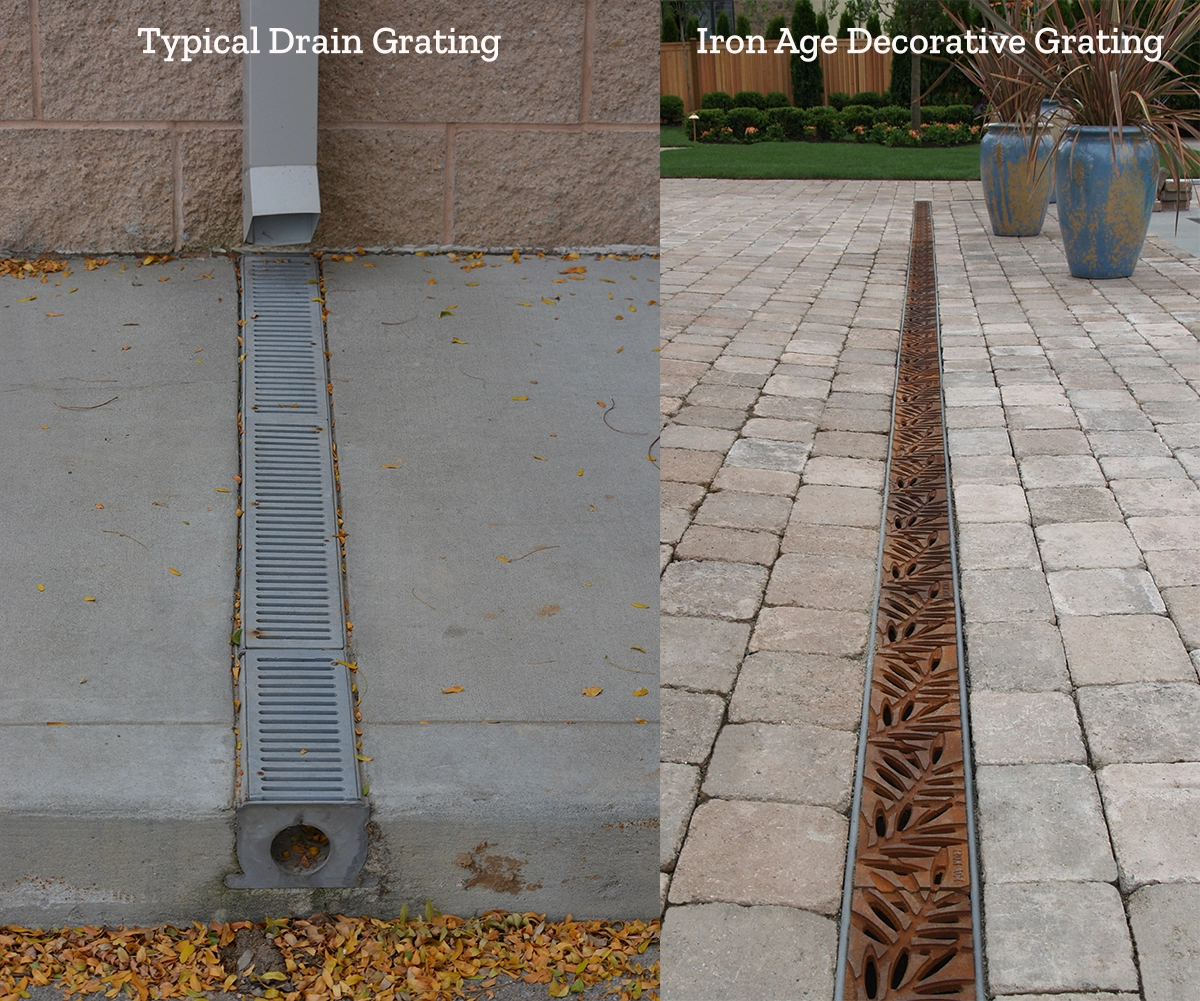
What makes Iron Age grates different from the typical drain grate?
Most drain grates are designed purely for utility.
Flat profiles, repetitive lines, and plastic materials are common—effective, but rarely considered part of the overall design. As a result, drain grates often feel disconnected from the surrounding paving and landscape.
Iron Age makes grates for designers.
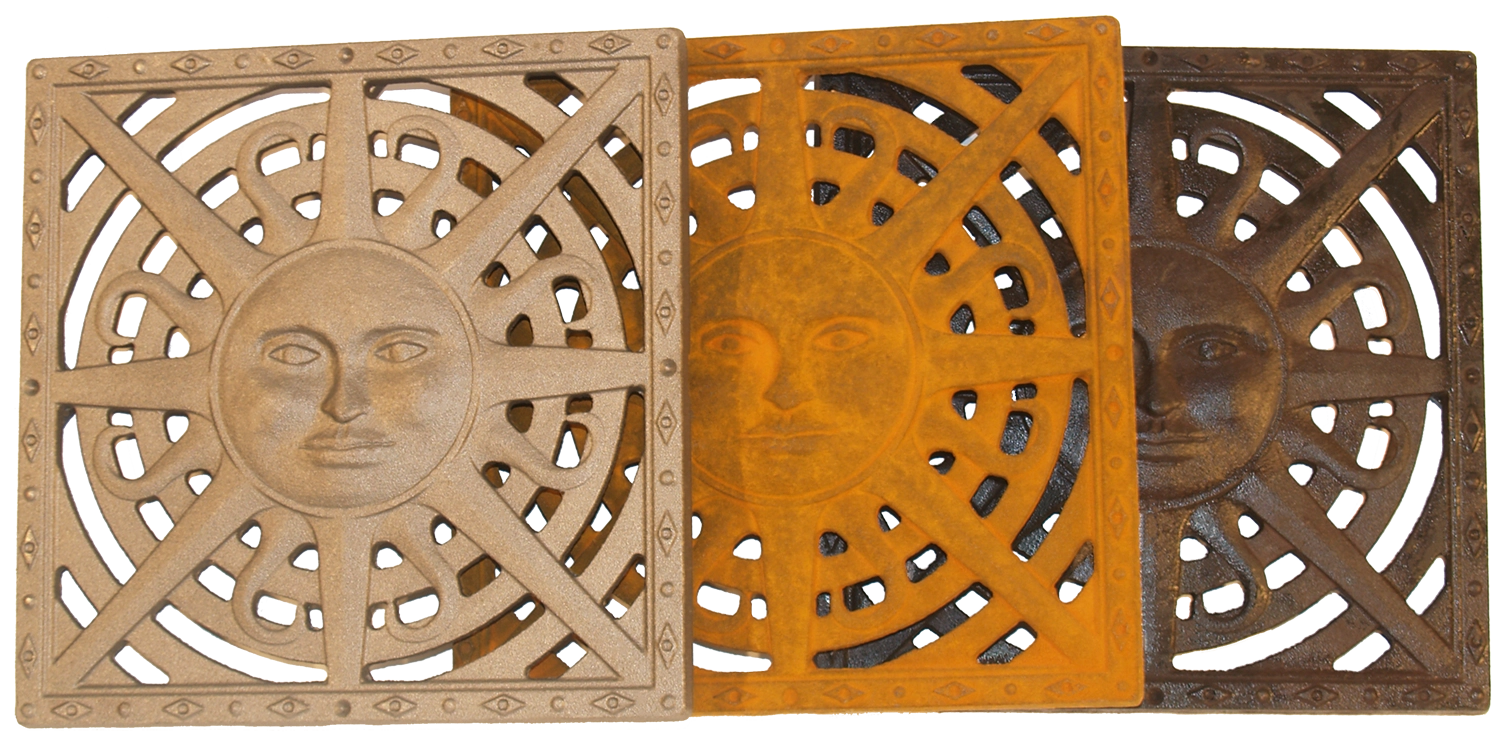
Our decorative cast metal grates feature dimensional patterns and sculptural relief that turn a functional necessity into a visible design element. Rather than fading into the background or competing with adjacent materials, our grates are designed to work in harmony with paving layouts, planting, and architectural detailing.
Designed to work with standard drain systems.
Beyond aesthetics, Iron Age trench and catch basin grates are sized to fit the most widely used drain bodies on the market. This allows designers to specify decorative grates without adding complexity or unnecessary cost. Our Made to Fit Your Drains resource explains how to quickly confirm compatibility for your project.
How do I know which Iron Age grates will fit the drain body I am using?
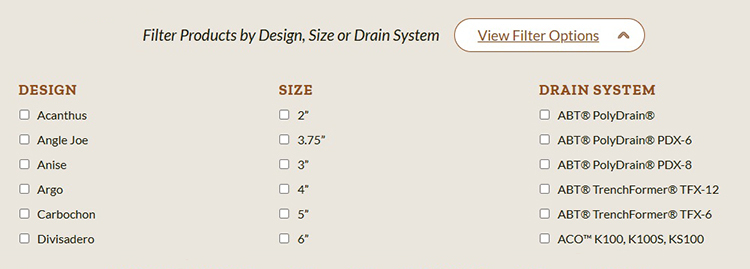
In the Products section of the website, select a product category (such as trench grates or catch basin grates), then use the By Drain System filter to choose the manufacturer and drain body you are working with. The filter will display the Iron Age grates available to fit that drain body—making it quick and straightforward to confirm compatibility.
Are all Iron Age grates made from recycled/recyclable materials?
Our cast metal products contain a minimum of 80% recycled materials, and are all 100% recyclable, helping to earn your project LEED accreditation.
What materials and finishes are available?
Iron Age offers a variety of materials and finishes that each have their own unique properties. Some of the most common materials we work with are Bronze, Aluminum, Ductile Iron and Grey Iron. Finish options include Baked-On-Oil and Powder Coating. For details, see “Materials and Finish Options” in our RESOURCES section.
Why are my cast iron grates turning orange?
Raw cast iron starts out grey in color, but when exposed to moisture, a bright orange oxide—commonly referred to as rust—will develop. This initial oxidation is a natural and expected part of the material’s aging process.
Over time, the loose surface rust wears away and is replaced by a tightly adhering oxide layer that protects the metal beneath. The result is a stable, warm reddish-brown patina similar to what you see on traditional manhole covers and historic cast iron elements.
For more detailed information about cast iron oxidation, see “Materials and Finish Options” in our RESOURCES section.
What can I do if I don’t want orange grates—even temporarily?
We generally recommend letting our grates age naturally, but for those who prefer to bypass the bright-orange oxidation phase of raw iron, we offer an eco-friendly “Baked-On-Oil Finish”. For specifics, see the “Materials and Finish Options” page under the “RESOURCES” tab.
How do I find out the free drain area of the grate and how many gallons per minute it can handle?
When you visit the product page of the grate you are interested in, the free drain area (listed as a percentage) and gallons per minute will be found in that product’s “Detailed Specifications.” If you don’t see “Free Drain Area” or “Gallons Per Minute (GPM)” listed, contact us and we will be happy to provide the information.
What is the load rating for traffic? Can cars drive over the grates?
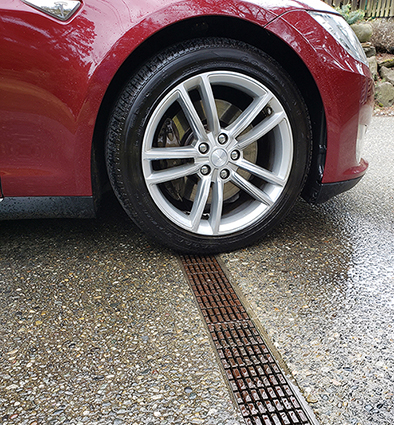
The majority of our grates have not been rated for specific loads, but they have been designed at a minimum to withstand single-axle vehicles/residential traffic (Load Class B), regardless of material used.
If your trench and catch basin grates need to be installed in an area with commercial traffic (Load Class C, D or E), we suggest casting in ductile iron, which has more flexibility and a higher strength-to-weight ratio.
If your project has requirements for specific loads, we can provide any classification or engineering calculations needed upon request. Contact us with the details.
ADA Compliance & Heel-Proof
What makes Iron Age grates ADA compliant?
All Iron Age Designs grates are designed to meet ADA (Americans with Disabilities Act) requirements for accessibility and safety in walking surfaces.
Opening size:
ADA guidelines allow a maximum opening of 1/2 inch in the dominant direction of travel. A simple way to visualize this: if you rolled a 1/2-inch ball bearing across the surface of one of our grates, it would never fall through.
Slip resistance:
ADA-compliant walking surfaces must also meet minimum slip-resistance standards, measured by a coefficient of friction of 0.6 or higher in both wet and dry conditions. The natural texture of our as-cast surface and our baked-on oil finish exceed this requirement. While powder coating is an option, we generally do not recommend it for grates in the ground plane, as most colors slightly reduce slip resistance.
Surface transitions:
To prevent tripping hazards, ADA guidelines also limit vertical changes in surface height. Grates may not exceed a 1/4-inch vertical rise, or up to 1/2 inch when designed with a gentle 1:2 slope.
How is that different than “Heel-Proof”?
“Heel-proof” refers to a different design approach, not an ADA standard. Heel-proof grates use smaller openings—typically 1/4 inch or less—to better accommodate high-heeled shoes.
While this creates a smoother walking surface for heels, smaller openings can significantly reduce drainage performance. In outdoor applications, 1/4-inch openings are more prone to clogging with debris, which can compromise water flow.
For projects where heel-proof grates are desired, we recommend carefully considering the environment and maintenance needs, and weighing the trade-off between walkability and drainage performance.
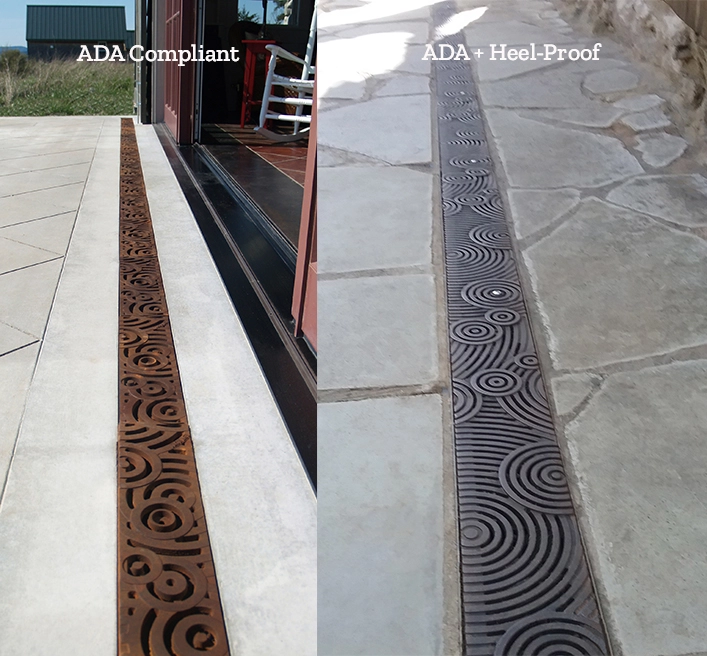
Oblio trench grates with 1/2″ openings on left; 1/4″ openings on right.
Sustainability
Why material choice matters in sustainable design
Sustainability can mean many things. At Iron Age Designs, we define it as doing business in a way that supports ecological, human, and economic health—both now and into the future.
That philosophy starts with material choice. Our products are made from some of the most natural, durable, and endlessly recyclable metals available.
By focusing on materials designed to last for decades rather than years, we reduce the need for replacement and minimize waste over the life of a project. In our view, longevity is one of the most meaningful measures of sustainability.
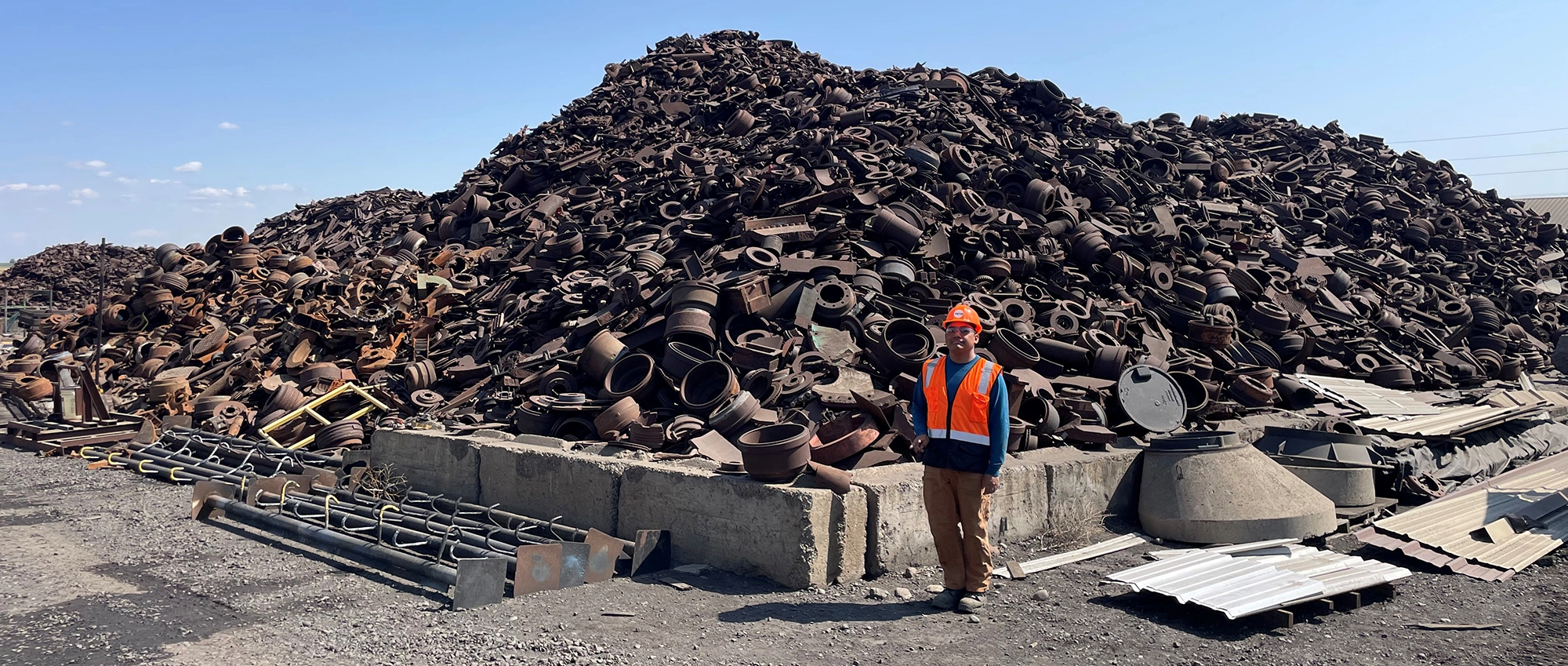
Raw metal awaiting reuse at one of the U.S. foundries we partner with—material that will be melted down and recast into Iron Age products.
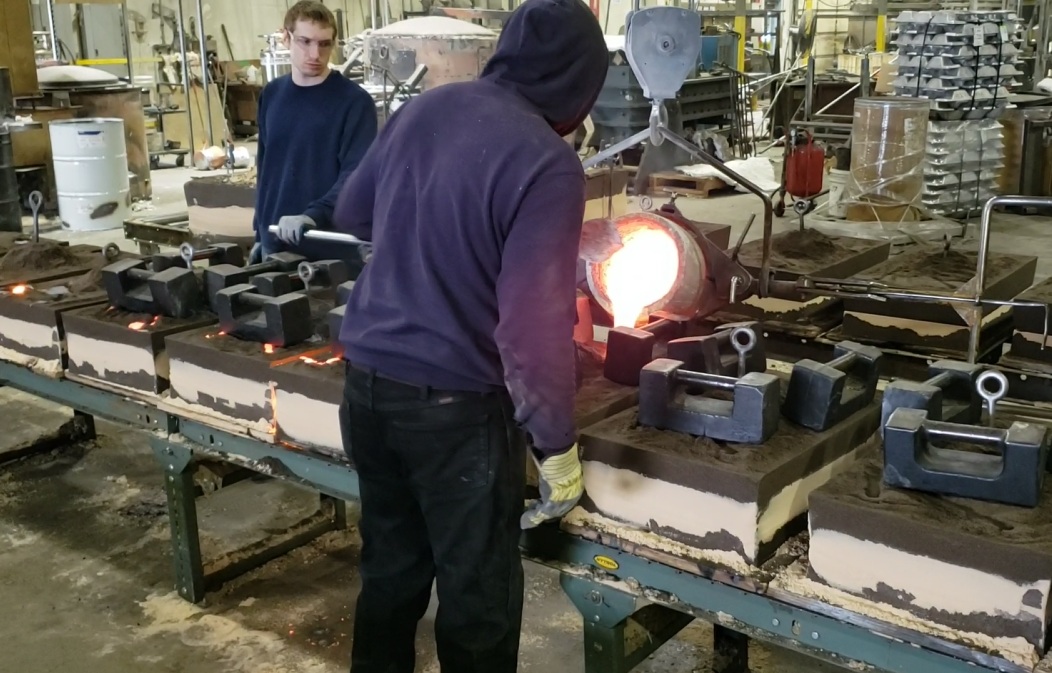
Domestic foundry production helps reduce transportation impacts while supporting skilled labor and long-term quality.
Why local manufacturing is part of our sustainability approach
We proudly design and manufacture approximately 97% of our products in the United States, sourcing materials locally whenever possible. Keeping production close to home supports skilled jobs, reduces transportation impacts, and allows us to maintain a high level of care and accountability throughout the process. It also delivers real benefits to our customers, including:
-
Better control over manufacturing, resulting in higher-quality products
-
Faster issue resolution and clearer communication
-
Greater flexibility for custom details or late-stage changes
-
Shorter lead times and quicker shipping
-
A reduced overall carbon footprint compared to international sourcing
Because we manufacture through several foundries across the country, many projects may also be eligible for LEED credits related to local production. Contact us to learn more about how Iron Age products can support your sustainability goals.
Custom Designs
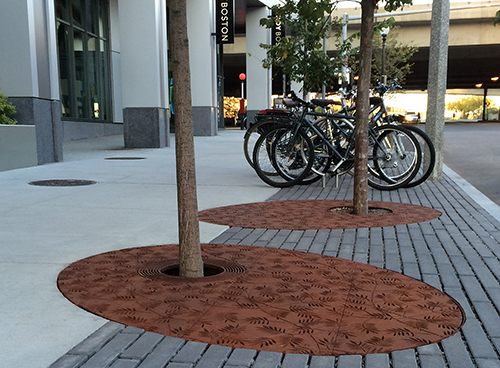
Custom oval tree grates in our Locust pattern
When a project calls for custom work, think of Iron Age as a trusted partner.
We understand the opportunities and constraints of different materials and manufacturing processes, and we use that knowledge to advise on what’s possible, what’s practical, and where small adjustments can save time, cost, or complexity without compromising the original design intent.
Many custom Iron Age projects begin with an existing pattern, adapted for a specific application. Modifying size, shape, orientation, or detailing—such as transforming a standard Locust tree grate into an oval configuration—often allows projects to achieve a tailored result while maintaining proven performance and efficiencies. When a project calls for something entirely new, we also collaborate closely with designers to develop fully custom cast solutions from the ground up.
Explore our Custom products section for inspiration and examples of our work, then contact us to start a custom consultation.
I need a custom grate, but only one—can you make that for me?
We are able to create entirely new grate designs, including custom patterns developed specifically for a project. However, because cast grates require a dedicated pattern, the upfront tooling costs for a brand-new design typically run into the thousands of dollars. For a one-off grate, that can make starting from scratch cost-prohibitive.
A true one-off is most appropriate when the grate is a highly visible focal element, tied to a unique architectural feature, or part of a project where design intent clearly outweighs tooling cost considerations.
That said, many single-grate requests can be addressed without creating a new pattern. We frequently work with designers to modify existing Iron Age patterns—adjusting size, shape, orientation, or detailing—to achieve a custom result that meets both budget and performance goals. Contact us to talk through your project, and we’ll help you identify the most effective approach, balancing cost, functionality, and design intent.
Can you cast grates on a radius (circles and ovals)?
Iron Age can accommodate virtually any radius, using either standard-size products adapted for the application or a fully custom approach, depending on the project.
Circular grates typically require a single pattern that repeats to form a complete ring. Ovals, by contrast, have a changing radius and may require multiple patterns to achieve a true, continuous shape. In some cases—particularly with larger circles or ovals—no new pattern is required at all. As the overall size increases, the change in radius at each connection point becomes very slight, resulting in minimal or visually negligible gaps.
For additional guidance on planning a project with radius grates, see Designing Radius Installations in our RESOURCES section.
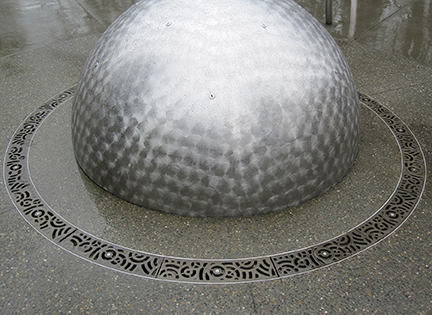
Oblio 5″ circular radiused trench in cast bronze.
Frames & Installation
FRAMES
Custom frames provide a stable bearing surface.
Radius grates, custom sizes, and tree grates require Iron Age custom frames. Fabricated from steel angle bar, our frames are bolted or wet-set into the top edge of a drain opening to create a consistent, durable surface for the grate to rest on.
Frames help protect surrounding materials.
By separating the cast iron grate from adjacent paving or concrete, the steel edge of the frame helps reduce direct contact and mitigates the potential for rust staining at the surrounding surface.
Made to order for real-world site conditions.
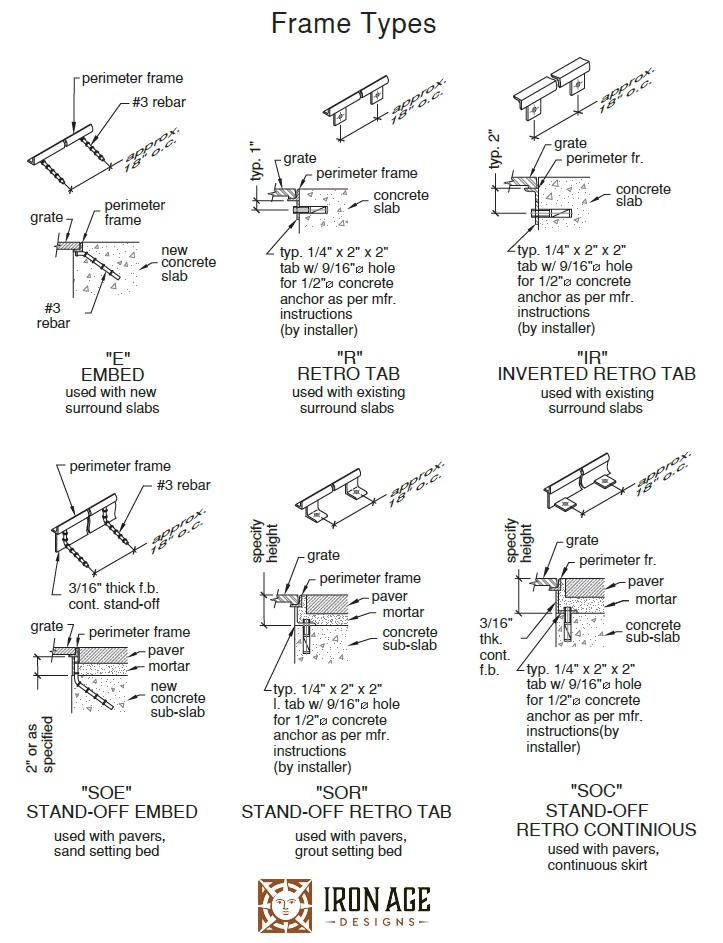
All Iron Age frames are made to order and designed to accommodate a wide range of installation conditions. Frame options include embedment frames for new concrete pours, stand-off frames for use with various paver systems, and retrofit frames for existing slabs.
Early coordination is key.
Because frame selection is closely tied to finish materials, site conditions, and construction sequencing, early coordination with the design team, civil engineer, and concrete or paving trades is strongly recommended.
FRAME OPTIONS & INSTALLATION GUIDANCE
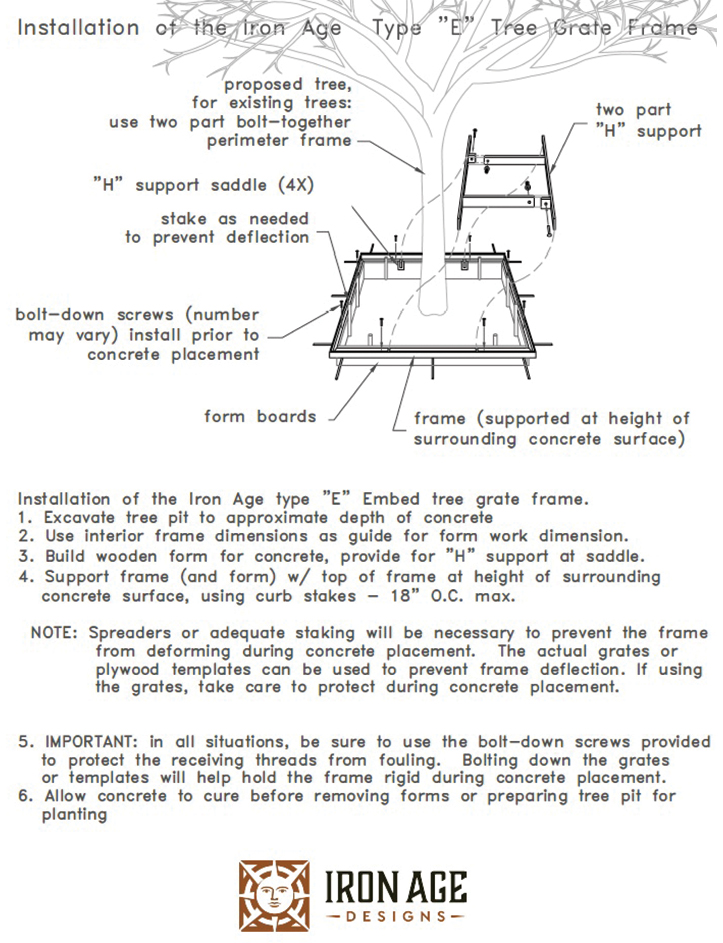
Below you’ll find answers to common questions about frame options and limitations, along with descriptions of our frame types and installation guidance for standard “E” (embedment) frames.
Need help selecting the right frame? Contact us to talk through your installation conditions.
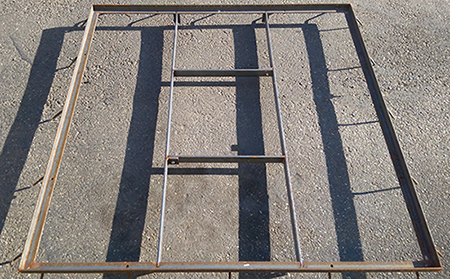
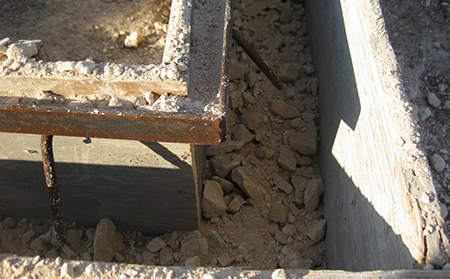
Iron Age embedment frame shown prior to installation (top) and during placement, with rebar extensions designed to anchor the frame securely into the concrete pour (bottom).
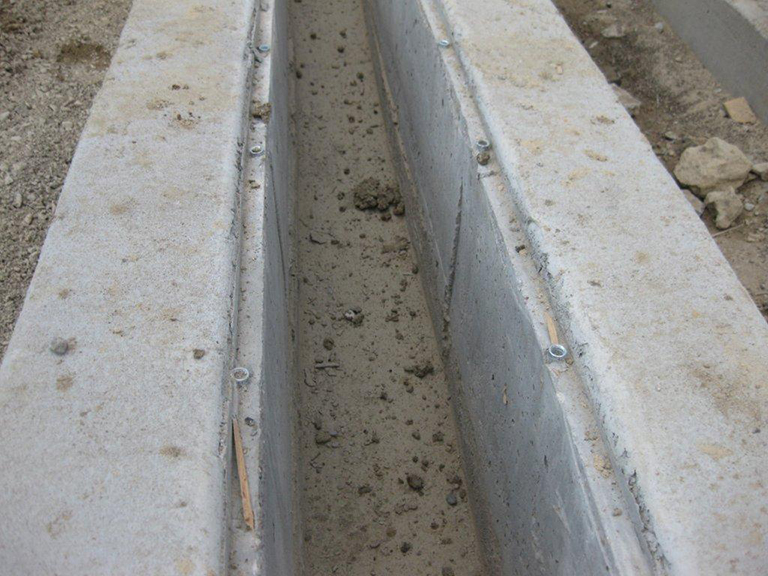
Example of concrete trench “frame”
Can I build a “frame” from concrete?
In some cases, a concrete ledge can be formed to act as a bearing surface for a grate. While this approach may offer an initial cost savings, concrete edges are prone to chipping and deterioration over time, particularly in high-traffic areas or freeze-thaw environments. For long-term durability and consistent support, a metal frame is typically the more reliable solution.
Why don’t you make frames from iron?
Casting frames—especially for trench and tree grates—presents significant challenges. Long, narrow components are susceptible to warping during the casting process, making it difficult to maintain the dimensional accuracy required for proper fit. For this reason, fabricated steel frames are almost always the preferred and more dependable method of manufacture.
Can I use a major manufacturer’s drain body for a radius trench channel?
Generally, no. Radius trench applications require custom frames, as standard trench systems are designed for straight runs and cannot accommodate curved geometry.
When a project calls for a curved or radial trench grate, Iron Age provides a custom frame engineered to support the required radius and ensure proper fit and performance. Because radius trench solutions can affect layout, drainage flow, and construction sequencing, early coordination with the design team and civil or plumbing trades is strongly recommended.
For additional guidance on planning a radius trench application, see Designing Radius Installations in our RESOURCES section.
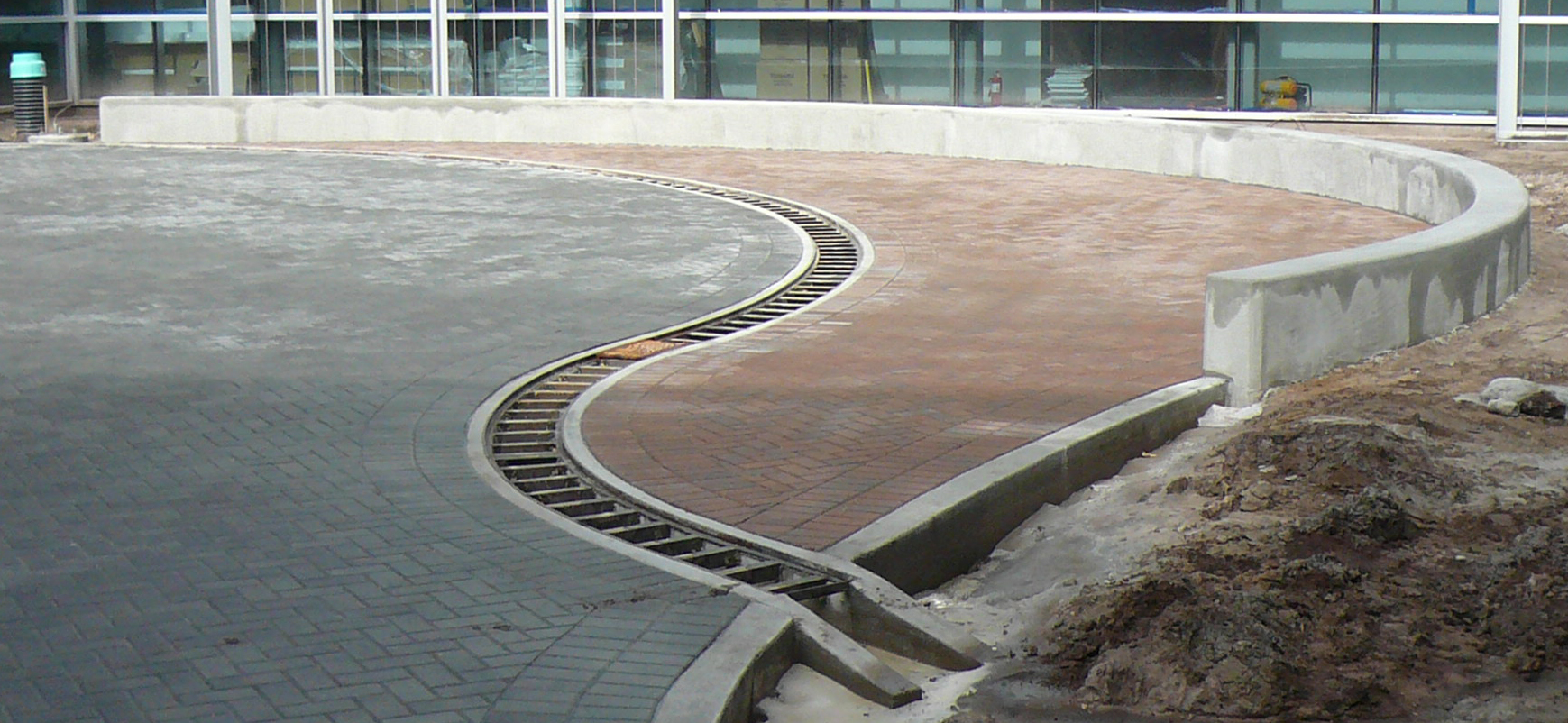
Example of radiused trench “embedment” frames
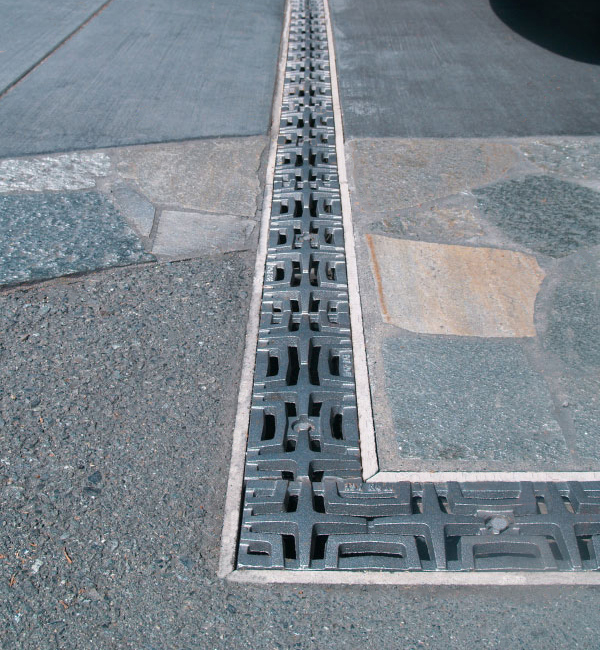
Carbochon 5″ trench grate bolted down to secure grates against removal
INSTALLATION
Can Iron Age grates be secured in place?
Yes. All Iron Age grates include bolt holes or drill points that can be opened as needed, allowing grates to be secured to the drain body or frame.
Before securing a grate, we recommend weighing security needs against the convenience of being able to remove the grate for periodic drain maintenance—particularly in residential applications.
Cast iron tree grates are heavy and have limited resale value, making theft uncommon. That said, when fastening is desired, we make it easy: Iron Age is the only manufacturer that ships all tree grates with mounting bolts included at no additional charge.
For aluminum or bronze grates—especially larger sizes or installations in areas with higher security concerns—tamper-resistant fasteners are also available upon request.
Pricing
How much do Iron Age grates cost?
Because our grates are available in a wide range of sizes, patterns, materials, and load ratings, pricing varies significantly from project to project. The figures below represent starting points within each category to help you understand general budget expectations.
We do not publish full pricing schedules online, as most projects require coordination around size, finish, frame type, shipping, and installation conditions. Sharing your project details allows us to provide accurate pricing tailored to your needs, rather than generalized numbers that may not apply to your situation.
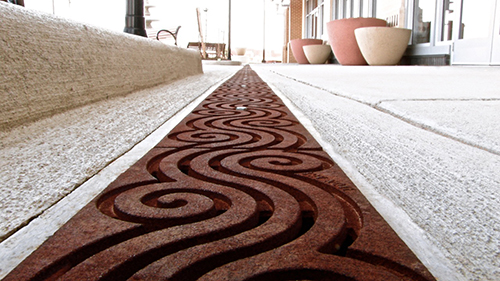
Trench Grates
Pricing typically starts at approximately $50+ per linear foot for smaller, standard sizes. Wider or heavy-duty applications will increase in cost depending on size and material.
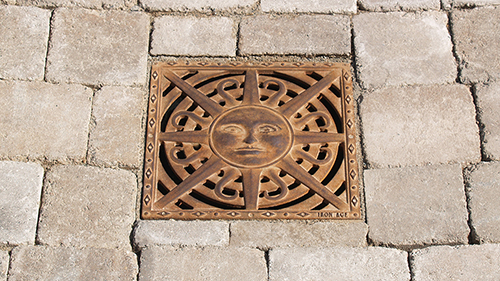
Catch Basin Grates
Pricing starts at approximately $50+ for small pipe grates. Larger grates and custom sizes represent a greater investment based on dimensions and load requirements.
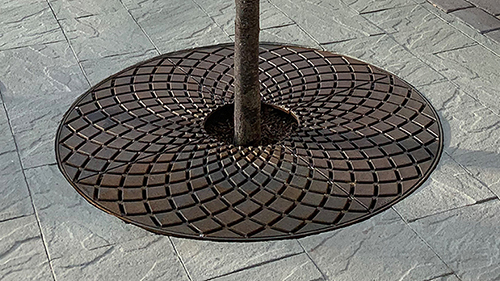
Tree Grates
Pricing varies significantly based on size, thickness, and weight. Pricing typically starts at $950+. For complete pricing—including frames—we recommend contacting your sales representative or using our Request a Quote form.
All pricing above reflects raw cast iron grates. Cast bronze and cast aluminum options are available at a higher cost.
For project-specific pricing, fill out our Request a Quote form. We can recommend appropriate materials, finishes, and frame types, and provide lead times and estimated shipping costs.
Are less decorative grates less expensive?
Not necessarily. Grate pricing is driven primarily by the weight of the casting, as material volume is the largest cost component.
In some cases, additional factors—such as the manufacturing process, foundry production requirements, or special load ratings—can also influence pricing. However, for grates within the same size and load category, simpler patterns are typically priced the same as more intricate designs if they weigh approximately the same.
For example, our 5″ Regular Joe trench grates are visually simpler than some of our other 5″ patterns, but because all 5″ trench grates weigh approximately the same, they are priced the same.
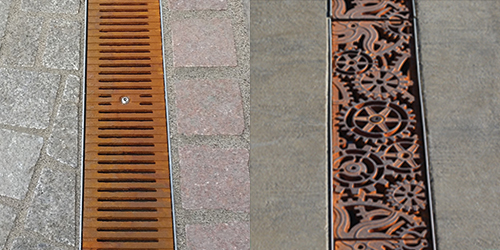
Regular Joe (l) and Dynamo (r) trench grates, priced the same due to comparable casting weight.
How do the costs of different materials compare?
Material choice has a significant impact on cost:
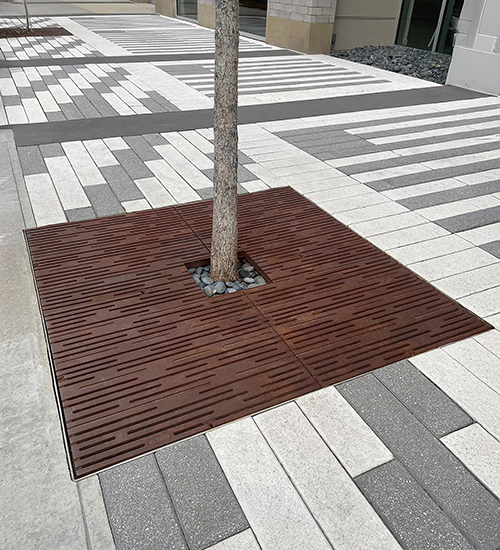
Ductile Iron
Provides increased strength and impact resistance for applications where additional durability is required. This enhanced performance typically comes at a higher material cost than grey iron, and is best reserved for projects where those benefits are needed.
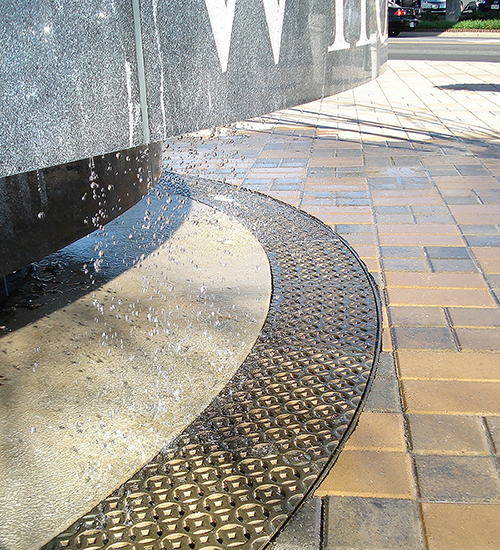
Cast Bronze
Typically, the most expensive material option, generally costing three to four times more than cast iron. It is well-suited for high-visibility applications and environments with frequent moisture exposure, where its corrosion resistance and natural patina are valued.
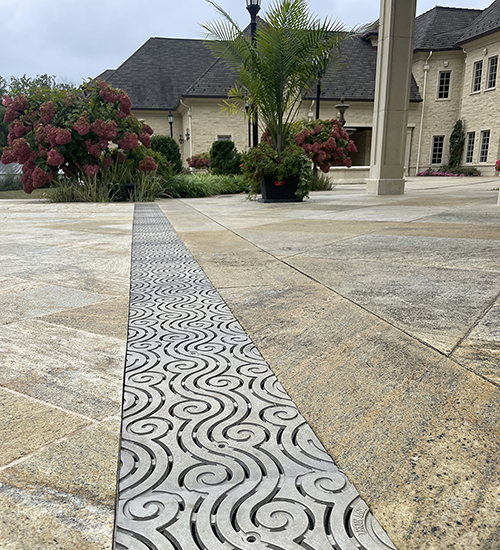
Cast Aluminum
Falls between cast iron and cast bronze in terms of cost and offers the benefit of reduced weight, which can be helpful for handling and installation. Its naturally cooler color palette and clean appearance make aluminum a popular choice for modern or contemporary designs.
While budget can influence material selection, the intended use and environment are often the deciding factors. For more detail, visit Materials & Finish Options in our RESOURCES section or contact us to discuss the best choice for your project.
How do the costs of different finish options compare?
Pricing for our Baked-On-Oil and standard powder coat finishes is generally comparable, starting at approximately $24 for a 3″ trench grate and increasing based on size.
Please note:
- Powder coating has a $150 minimum charge
- E-coat plus powder coat is approximately twice the cost of standard powder coating.
Contact us for a project-specific quote with finish pricing and lead times.
Ordering
How do I place an order with Iron Age?
To get started, visit our Contact page and select your location to find the Iron Age sales representative for your area. Your representative can consult with you on your project, provide a detailed quote, and help guide your order from start to finish.
If no contact information is listed for your region, you can reach us directly at (877) 418-3568, email [email protected], or submit a Request a Quote form. We’ll follow up with the information you need and connect you with the appropriate support.
Do you have order minimums?
No—there is no minimum order. Whether you need a single grate or a large quantity for a multi-phase project, we’re happy to help.
I like one of your designs, but don’t see it in the size I need. Can I order a different size?
Iron Age grates are cast, not fabricated, which means producing an existing design in a new size typically requires creating a new casting pattern. Pattern charges vary widely depending on size, complexity, and project requirements.
Because every project is different, the best approach depends on your goals, budget, and timeline. Sometimes developing a new pattern is the right solution; other times, we can achieve a similar result by refining an existing design or adapting another Iron Age product.
We encourage conversations early in the process so we can make a project-specific recommendation and help identify the most practical path forward.
What is your typical lead time?
Lead times vary depending on the product, material, finish, and quantity.
Standard products.
Smaller quantities of standard trench and catch basin grates in raw cast iron are often in stock and may ship as quickly as the next business day. If a Baked-On-Oil or powder coat finish is requested, please allow approximately 10–14 additional days
Made-to-order and custom products
Items made to order—including some trench and catch basin grates, all tree grates, custom and radius grates, frames and site furnishings—have lead times that vary based on project complexity, materials, finishes, and quantities
If you have a specific timeline, let us know early in the order process. We’ll do our best to accommodate your schedule and flag any constraints upfront
Can I order other manufacturers’ drain bodies through you?
Iron Age focuses primarily on the grate portion of the drainage system. In most cases, we do not sell other manufacturers’ drain bodies and recommend sourcing them locally through your preferred supply house or directly from the manufacturers listed below.
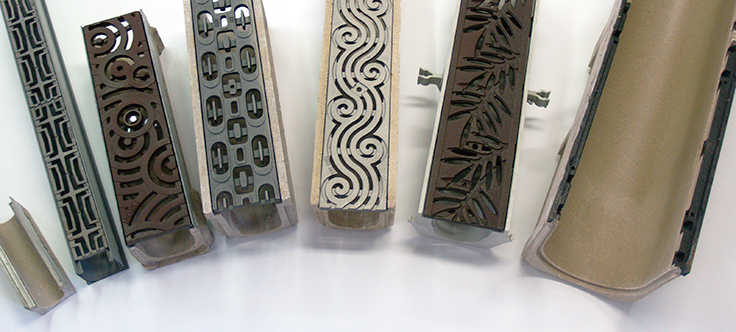
That said, for customers who prefer a more streamlined approach, Iron Age can also help coordinate complete drainage solutions. Through our distributor network, we can provide select drain bodies from ANRIN™, MEA®, and NDS®, packaged with compatible Iron Age grates—simplifying specification, sourcing, and coordination.
For help confirming compatibility, visit our Made to Fit Your Drains resource or contact us with your project details.
Shipping
What information is needed to estimate shipping charges?
To provide the most accurate shipping estimate, we’ll need a few key details about the delivery location and site conditions. Shipping costs can vary based on access, equipment, and handling requirements
Delivery address type
Let us know whether the shipment is being delivered to a job site, residence, or another limited-access location. If the delivery address is not zoned as commercial—even if it’s a home-based business—it will typically incur either a limited access charge from freight carriers or a residential surcharge from UPS.
Site access and equipment
Please confirm whether there will be an accessible loading dock or forklift available at the delivery address. If neither is available, the freight carrier will apply an additional lift gate fee to safely unload the shipment.
Providing accurate delivery location information upfront allows us to identify the best carrier and most appropriate shipping option for your project.
How will I know when my Iron Age shipment is due to arrive?
Clear communication is essential for a smooth delivery. Before your shipment leaves our warehouse, foundry, or frame shop, we’ll need complete contact information for each stage of delivery.
Delivery contacts
Please provide the name, phone number, and email address for the primary point of contact on the order, as well as the name and phone number of the person who will be accepting the shipment on-site.
Tracking and notifications
Once your order ships, we’ll email you either:
- A freight carrier PRO number, or
- A UPS tracking link, depending on the shipping method
Freight shipments can be tracked on the carrier’s website using the PRO number, while UPS tracking links will take you directly to shipment status details.
Freight delivery appointments
For freight shipments, the on-site delivery contact will receive a phone call from the carrier approximately 24 hours before delivery to schedule an appointment.
- It’s important to ensure someone is available during the delivery window to receive and sign for the shipment.
- Delivery drivers generally do not assist with off-loading and will not leave a shipment unattended.
I need my frames ASAP. Can you ship them before my grates?
In many cases, yes. Customers sometimes request that frames be shipped ahead of grates to keep projects moving, and we can often accommodate this request. Please note that additional shipping charges may apply when frames and grates ship separately.
There is one important exception: radius frames and frames for new or fully custom products. Because of the geometric complexity involved, these frames must be fit-checked with the corresponding grates before shipment.
Iron Age custom frames are manufactured in partnership with a local fabrication shop. For radius trench grates and new/custom designs, the cast grates must be provided to the fabricator before the frames are released. This fit-up process ensures proper alignment and a precise final fit. Once verified, the frames and grates are shipped together for installation.
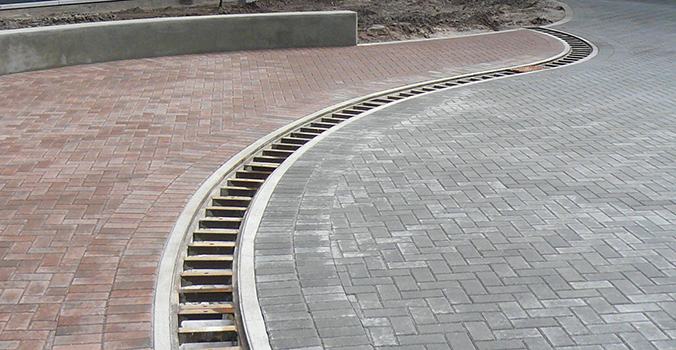
The curved geometry of radius frames requires careful fit-up with the grates before shipment.
Terms & Conditions
For Purchase Orders, Payment and Account Set-Up:
Iron Age Designs | 2104 SW 152nd St., Suite 4 | Burien, WA 98166
Payment
Iron Age Designs accepts payments made by check, ACH, wire transfer and credit card (credit card payments not to exceed $5,000 per order). All orders must be prepaid unless credit terms have been established in advance.
Credit applications may be requested by emailing [email protected].
A minimum 50% deposit is required for orders that include (but are not limited to):
- Products made of bronze or aluminum
- Custom fabrication, finishes, or patterns
- Large or non-stocked items
Taxes
Iron Age Designs has tax nexus in Maryland, Washington, and Washington, DC, and will collect applicable sales tax on orders shipped to these locations unless a valid tax exemption certificate or reseller permit is provided.
For shipments to other states, Iron Age does not collect sales tax. Any applicable taxes in those locations are the responsibility of the customer.
Warranty
Under normal conditions, Iron Age products are designed to perform their intended function for many years. If an issue arises, we take a problem-solving approach and work toward a successful resolution.
Iron Age warrants its products to be free of defects in material and workmanship for one year from the invoice date. This warranty:
- Applies only to products supplied by Iron Age
- Does not cover abnormal use or abuse
- Does not include labor or related replacement costs
Iron Age’s responsibility is limited to replacement of products determined to be defective (photographs will be required). Extended warranties may be available on a case-by-case basis.
Load Ratings (Grates)
- Grates 14” wide or less are designed to withstand, at a minimum, single-axle residential vehicle traffic when properly installed.
- Grates rated for heavy vehicular or commercial traffic will be specifically designated as Heavy-Duty.
- Grates without a Heavy-Duty designation should be considered Pedestrian-Rated.
- Grates spanning more than 14″ are Pedestrian-Rated unless otherwise noted.
Pedestrian-rated grates may achieve heavy-duty load ratings when used with reinforced frames, evaluated on a case-by-case basis. Engineering calculations or load testing can be obtained for specific vehicular load conditions at additional cost (see Engineering Calculations).
Lead Times
Lead times are based on production capacity at the time of quoting and are subject to change. Updated lead times will be confirmed once an approved order is received.
Production begins upon receipt of:
- Purchase order or signed Iron Age quote
- Approved drawings/submittals (if required)
- Deposit, based on agreed payment terms
Lead times are estimates only. Iron Age is not responsible for site or construction delays. Orders ship upon completion. If an order cannot be received when ready, storage fees may apply for materials held longer than one week.
Engineering Calculations
Engineering calculations, when required, occur after submittal drawings are approved for dimensions, installation, and appearance. These calculations verify load designations and must be approved before manufacturing begins.
Unless otherwise noted, calculations are performed by independent engineering firms licensed in Washington State. Engineering lead times vary and are separate from manufacturing lead times
Installation Hardware
Installation or mounting hardware is not included unless specifically quoted. Frames ship with bolts for attaching grates to frames but do not include additional hardware.
Cancellation & Restocking Policy
- Stock items: Subject to a 25% restocking fee. Items must be returned with prior authorization, shipping prepaid, and in resellable condition.
- Made-to-order items: A 50% cancellation fee applies if cancelled prior to shipment.
- Shipped orders: Once shipped, 100% of the invoiced amount is due.
Custom order deposits are non-refundable. Custom products, finishes, cut grates, and custom frames are not eligible for return. Any policy exceptions must be approved in writing.
FREIGHT TERMS & CONDITIONS
Freight Responsibility
Iron Age Designs supplies materials only. Independent freight carriers handle delivery. Responsibility transfers:
- To the carrier once product is loaded
- To the customer once delivery is signed for in good order
Offloading is the customer’s responsibility. Due to product weight, a forklift is often required. Liftgate service is available upon request and may incur additional charges.
Inspecting Freight
All shipments must be inspected immediately upon delivery. If damage or discrepancies are visible:
- Refuse delivery or
- Accept delivery and clearly not damage on the carrier’s Bill of Lading (BOL)
Photographs must be taken at delivery, and Iron Age must be notified immediately with the order number, BOL number, and documentation.
If freight is signed for as complete and undamaged, Iron Age will assume delivery was accepted in good condition and payment will be expected per agreed terms.
Freight Claims
- Count and compare all items against the packing slip and BOL at delivery.
- Claims for missing or damaged items must be made at the time of delivery.
- Claims submitted after signing without notation will not be accepted.
Frames: Bolts for attaching grates to frames are typically boxed and taped to one of the frames. Please locate and store them upon delivery. Claims for missing hardware must be made at delivery; replacement costs and shipping will apply if reported later.